

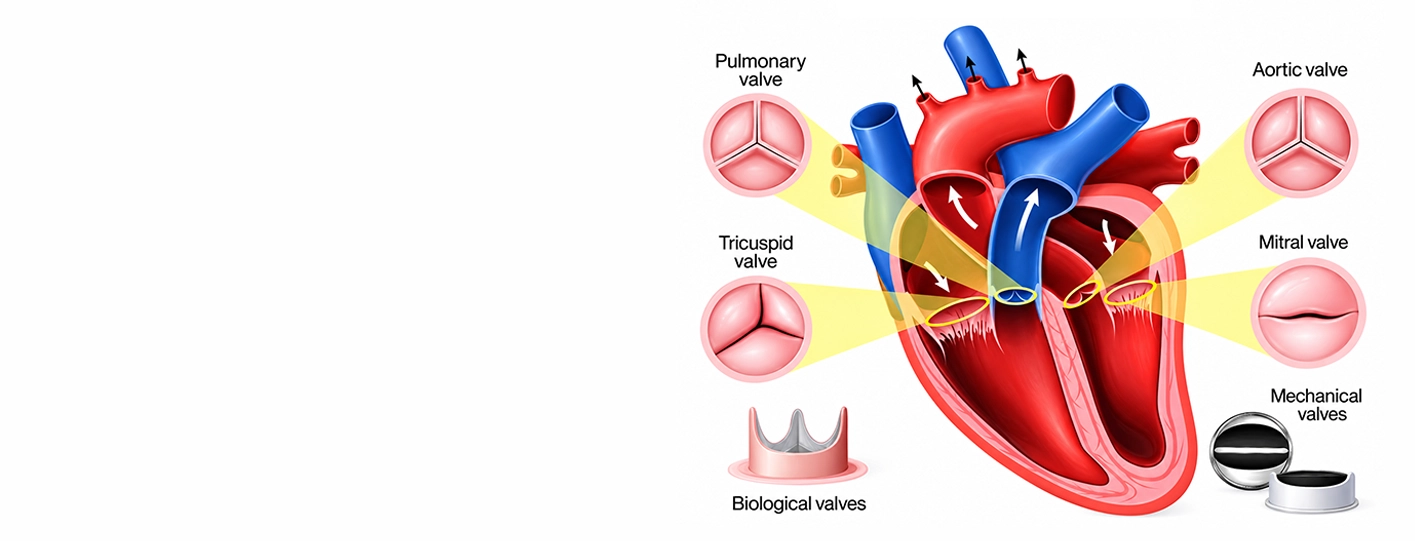
Heart valve disease is a condition marked by the inability of the valve to open properly or close tightly. The former is known as stenosis, whereas the latter is known as regurgitation. The condition can affect one or more than one of the four valves of the heart. In most cases, just one of the valves is affected.
Heart valve disease is a significant cardiac concern in India, with rheumatic heart disease being one of the major contributors. In a study published in the Indian Heart Journal (2014), 136,098 first-time echo scans were reviewed, which led to the discovery of 13,289 cases of organic valve disease
Aortic valve disease and mitral valve disease are two of the most common types of heart valve diseases.
| Problem | What it means | Common valves |
| Stenosis | The condition is marked by narrowing or stiffening of the valve, which restricts normal flow of blood | Commonly seen in aortic and mitral valves |
| Regurgitation | It is marked by the inability of the valves to close properly, resulting in the backward leakage of blood. | Usually affects the aortic, mitral, tricuspid valves |
| Prolapse | It is marked by an abnormal backward bulge in the valve flaps. | Affects the mitral valve |
Symptoms of heart valve disease are often silent initially, and these start to appear when the disease has progressed. These also depend on the valve involved. These include:
It is important to note that these symptoms may also be triggered by other conditions; hence, it is advisable to consult a specialist and get yourself evaluated for proper diagnosis and personalised treatment.
Heart valve disease diagnosis involves:
Treatment for heart valve disease depends primarily on which valve has been affected, how severe the damage is, the symptoms experienced by the patient, the patient's age, and the overall health.
In the case of mild valve disease, doctors may recommend monitoring and medicines. In such cases, patients require regular follow-ups to reduce the risk of complications like heart failure and irregular rhythm.
In case of mild valve damage, where restoration is possible, doctors may recommend valve repair. The idea is simple: to repair the damaged part of the valve using a catheter. The technique used is minimally invasive, which ensures faster recovery.
Valve replacement surgeries are recommended for patients whose heart valves have been damaged beyond repair.
There are two different surgical approaches that may be used.
One is open-heart surgery, or the conventional approach, in which doctors make a large incision in the patient's chest to directly access the valves and replace them.
The second approach is the minimally invasive one, i.e., transcatheter aortic valve implantation or TAVI, in which a tiny incision is made near the groin to introduce the new valve into the blood vessel, and from there, it is directed towards the heart using detailed imaging guidance.
A mechanical valve is quite different from a tissue valve. The main points of difference are:
| Feature | Mechanical valve | Tissue valve |
| Material | Carbon and metal | Pig, cow or human tissue |
| Lifespan | Very long-lasting | Usually 15 to 20 years |
| Blood thinner | Lifelong warfarin | Usually not needed long term |
| Considerations | Regular INR blood tests | May need replacement later |
Your doctor takes into account a number of factors to determine which valve would be better for you. These include your age, lifestyle, and overall health.
Recovery after heart valve surgery depends on various factors, including the type of surgery and the overall health of the patient. According to the NHS, complete recovery can take anywhere between 2 to 3 months after open as well as minimally invasive heart surgery. Patients may be required to stay in the hospital for a week following open heart surgery. However, in the case of minimally invasive procedures like TAVI, a stay of 2 to 3 days is required.
Here are a few things that you need to take care of during recovery:
Heart valve disease can be prevented only in some cases where the underlying cause is rheumatic fever caused by untreated strep throat. It is therefore important to treat the condition promptly and complete the antibiotic course prescribed by the doctor. Managing rheumatic fever efficiently automatically reduces the risk of heart disease.
You should see a cardiologist for heart valve disease when you experience any of the following symptoms:
Heart valve disease ranges from mild and watchful to severe and treatable with repair or replacement. An echocardiogram is usually the key test, and early assessment gives you more options. If you have breathlessness, chest pain or a known murmur, book an OPD consultation for a cardiac evaluation.
Heart valve disease is a condition in which the heart valves are not able to open or close properly.
The early symptoms of heart valve disease are breathlessness, tiredness, palpitations, and swelling in the ankles.
Heart valve disease is diagnosed with the help of medical examination and echocardiogram. In some cases, more imaging tests may be needed, such as ECG, X-ray, CT, MRI and angiography.
Yes, mild cases of heart valve disease may be treated with the help of medication without any need for surgery.
Valve replacement surgery is needed in cases where the valve has been significantly damaged and cannot be restored by valve repair.
This article is for educational purposes only. It is not medical advice and does not replace diagnosis or treatment by a qualified cardiologist. Treatment decisions depend on individual assessment, and no outcome can be guaranteed. Please consult a registered medical practitioner about any heart symptoms, and seek emergency care for severe chest pain or breathlessness.
From Recent Advancements in Heart Care to Tips and Tricks to make your Heart Healthy Again, stay updated with reliable and informative blogs by our experts.

 WhatsApp Us (24/7)
 +91 9070902010 (24/7)


 Previous



.webp)
